








In a stable world, a good decision stays good for years. But in today’s environment of rapid changes, the shelf life of even a brilliant decision is shrinking. Yet many teams still treat their past choices as permanent commitments, leading to unnecessary drag and defensiveness. Here is a framework for breaking that cycle.
The strongest leadership teams I work with share a quiet but powerful capability. They stay remarkably aligned with the changing environment - even as reality shifts. They don’t panic when results soften after a once-sound decision. They don’t get trapped defending past logic or rewriting history. Instead, they notice something important early, name it clearly, and adjust with confidence.
That capability isn’t luck. It’s a skill. And it shows up in how teams understand the difference between a "bad decision" and a "changing situation."
Decisions Are Moments, Capability Is Continuous
Most teams treat decisions like verdicts: right or wrong, success or failure. But high-performing teams treat decisions differently. They see them as experiments made in context—useful for as long as that context holds.
This mindset creates fluidity and agency.
When performance shifts, these teams don’t ask first, "Where did we mess up?" They ask, "What’s different now?"
That single question changes everything. It moves the team out of defensiveness and into awareness. Out of regret and into learning. Out of friction and into forward motion.
The real advantage isn’t perfect decision-making. It’s the ability to stay congruent with changing conditions.
The Pattern That Trips Teams Up
Here’s the pattern many leadership teams experience:
A decision made six months ago felt right at the time. Smart people evaluated the data, aligned on direction, and committed. Now, results are slipping. Execution feels heavier. Progress requires more effort for less return.
At this point, teams may fall into one of two traps:
- Regret: Questioning the original decision and the people behind it.
- Defensiveness: Doubling down on the original logic even as friction grows.
Both responses miss the more common truth: Often -
The decision wasn’t wrong. The situation changed.
Teams that can name this early avoid unnecessary conflict and keep their energy pointed toward the future instead of the past.
What This Skill Unlocks
When a team recognizes that a decision was right for its moment but no longer fits, something powerful happens:
- Learning accelerates. Past decisions become data, not baggage.
- Trust deepens. People see that choices aren’t permanent judgments on competence.
- Strategic agility increases. The organization stays responsive without thrashing.
This isn’t about being reactive or constantly changing course. It’s about staying aligned with reality as it actually is. That alignment is a core leadership capability—and it compounds over time.
How Teams Learn to Notice Change Early
This capability doesn’t arrive in a single moment of insight. It’s built through attention and practice. The signals of a changing situation are usually quiet at first:
- Workarounds become common. People succeed despite the system, not through it.
- Meetings carry an undercurrent. Conversations are polite but charged. Certain topics get avoided.
- Your strongest people ask new questions. "Why do we do it this way?" or "What would happen if..."
- Low-grade exhaustion sets in. Not burnout—just the friction of old tools or norms meeting new demands.
These aren’t problems yet. They are signals. Teams that respond early build resilience. Teams that ignore them get surprised later.
A Quarterly Recalibration Ritual
Rather than waiting for friction or failure, high-performing teams make recalibration a rhythm. They use structured conversation designed to strengthen the team’s adaptive muscle.
At Beyond Frontiers, we believe impactful, lasting changes are reinforced with Habit-forming exercises. Here’s an example of a 90-minute review to help your team recalibrate:
Step 1: Name a Key Past Decision (15 minutes)
Choose one or two meaningful decisions from the last 3–6 months that shaped how the team operates. Be specific.
- Not: "We prioritized execution."
- Instead: "We centralized all final hiring decisions with the founders."
Step 2: Notice What’s Changed (20 minutes)
List what’s different now—without judgment. Team size, customer expectations, market pressure, internal capabilities, pace, complexity. The goal is awareness, not evaluation.
Step 3: Test the Fit (30 minutes)
Assume the decision was right for its moment. Now ask:
- What benefit did we expect originally—and are we still getting it?
- What hidden costs are we paying now that weren’t visible then?
- If we were deciding fresh today, what would we choose?
The question is no longer "Was it good?" The question is "Does it still fit?"
Step 4: Decide What’s Next (10 minutes)
Choose deliberately:
- Continue (Consciously): The decision still serves the current reality.
- Recalibrate (Tune for Today): The core idea holds, but it needs tuning.
- Reset (New Approach): The situation has changed enough to require a new approach.
Note that continuing is an active choice, not a default.
Step 5: Communicate the Why (15 minutes)
If a shift is happening, explain it with clarity and respect. Honor what the old decision made possible. Frame the change as evolution, not correction.
When This Becomes Second Nature
Over time, something important changes. Someone in a meeting says, "I think the ground has shifted on this," and the response isn’t defensive—it’s curious.
The team moves quickly from noticing to adjusting. Energy stays focused forward. Decisions stop feeling like permanent commitments and start feeling like intelligent steps in an unfolding environment.
That is Organizational Congruence: alignment between how you operate and the world you’re actually operating in.
The Capability That Compounds
We cannot prevent change. But we can build the capability to recognize it early, talk about it clearly, and adapt without drama or delay.
Teams that develop this skill don’t just avoid regret. They move faster. They trust each other more. They learn in public. And they stay aligned—not with who they used to be, but with who they are becoming.
That’s the real distinction. Grace for the past, Clarity in the present, Alignment for what’s next.
Applying to your team
In your next leadership meeting, set aside 90 minutes. Choose one meaningful decision and run this recalibration together. You may find it still fits perfectly. Or you may unlock a conversation that strengthens your team’s ability to meet the future with confidence.
Either way, you’ll be building the capability that great teams rely on most: staying congruent with reality as it evolves.
0 Comments Click here to read/write comments
Most succession plans begin with a familiar and essential question: Who’s next?
Boards ask it. Executive search firms mobilize around it. Private equity partners track it closely.
And rightly so. Selecting the next leader is one of the most consequential decisions an organization will ever make. And yet, even with strong processes in place, executive search partnerships, internal development pipelines, detailed succession matrices, one critical lens is often underutilized:
Are we preparing the organization as intentionally as we are preparing the leader?
At Beyond Frontiers, we don’t enter with a mandate to redesign or replace your succession efforts. We enter to deepen and align them. Our work is about making sure the system is ready: so that your chosen leader can step into momentum, not misalignment. Succession, done with the right context and intention, isn’t a burden. It’s one of the most generative leadership opportunities an organization can have.
Why This Matters? Now More Than Ever.
Across sectors, leadership transitions are receiving more attention, more investment, and more care. And yet the outcomes remain inconsistent.
McKinsey reports that nearly half of leadership transitions fall short of expectations within two years. And 68% of new executives cite organizational culture and internal dynamics—not role scope or personal readiness—as the main challenge. That gap points to something important:
Even the best candidates can struggle when the system they inherit isn’t aligned, cohesive, or clear. And while most organizations are doing real, diligent work on the “who,” we’ve found that even the strongest succession plans benefit from a closer look at the “what”:
- What leadership ecosystem will this person be stepping into?
- What is the system currently optimized for—and what must it become?
- What unspoken dynamics might help or hinder a successful transition?
These aren’t challenges. They’re invitations. Succession is your opportunity to refresh alignment, clarify values, and prepare your organization for its next chapter.
A System View. To Strengthen What You're Already Doing.
We’ve partnered with organizations where search firms are already engaged, succession charts are in place, and internal talent is being actively developed. That’s exactly when our work becomes most valuable.
We don’t duplicate that process—we support and elevate it.
- For boards, we help align around not just who—but what success will truly require next.
- For search partners, our work serves as a collaborative complement—bringing insight into team dynamics, system alignment, and cultural readiness that enriches placement success and accelerates impact.
- For investors, we help preserve momentum and trust during a key value inflection point.
- For CHROs and talent leaders, succession often lives as both a strategy and a tension. You’re tracking potential, managing readiness, and aligning development plans—often while navigating competing expectations from the board and the C-suite.
- The Team Congruence Assessment is designed with you in mind: a light-touch, insight-rich tool that surfaces the invisible dynamics shaping leadership success. It helps move succession conversations from static plans to living systems—so you can champion not just continuity, but congruence.
Everyone in the succession ecosystem is doing important work. Our contribution is to help ensure the whole picture is being seen, together. In fact, some of our most rewarding work has been in partnership with executive search firms—where together, we’ve supported organizations in not just placing a great leader but preparing the ground so they can truly thrive.
Why We Start with Congruence
At Beyond Frontiers, we begin with congruence: the alignment between who you are, how you lead, and what your organization needs next. We explore:
- Whether leadership success is clearly defined and shared across stakeholders
- Whether your values are embedded and lived or overly concentrated in a few individuals
- Whether internal talent feels seen and stretched—or simply assessed
- Whether the board and executive team share a narrative for the next chapter—or are carrying different versions
These insights don't replace your succession plan, they enrich it. Because when the system is ready, the leader can actually lead.
Real-Life Lessons: Five Succession Stories, Five System Lessons
Every succession tells a story—not just of who was chosen, but what they stepped into.
Here are five well-known transitions that illustrate how system readiness shapes success:
Coca-Cola (1999): The Right Résumé, the Wrong Readiness
Douglas Ivester succeeded a legendary CEO but struggled to lead amid unclear board dynamics, weak cultural readiness, and poor stakeholder relationships.
Lesson: Even a well-qualified internal candidate can falter without a system prepared to receive them.
Procter & Gamble (2010s): Learning, Then Leading
After a rocky CEO transition in 2009, P&G recalibrated. They strengthened internal pipelines, clarified success criteria, and engaged the board in shaping future leadership.
Lesson: When the system is aligned, succession becomes not just possible—but powerful.
Amazon (2021): Succession by Design
Jeff Bezos handed over the reins to Andy Jassy, a long-time insider and builder of AWS. The move was years in the making, with deep alignment between strategy, structure, and stakeholder expectations.
Lesson: When succession is viewed as a multi-year system shift, not a last-minute search, leaders inherit clarity.
Microsoft (2014): System-Driven Transformation
Satya Nadella’s appointment marked not just a leadership change but a cultural shift. He stepped into a system that had begun loosening old models and was ready for his fresh leadership narrative.
Lesson: When the system is ready to evolve, the leader can catalyze it.
Starbucks (2000s–Current): System Memory & Founder Reliance
Howard Schultz’s multiple returns to the CEO role revealed a deeper issue: the brand’s identity, cultural clarity, and leadership expectations were often too closely tied to his presence. Even capable successors like Kevin Johnson struggled to maintain strategic and cultural continuity.
Lesson: Without intentional system-level transition planning, leadership risk increases—even when founder legacy is strong.
These stories aren't meant to name-and-shame or hold up heroes. They’re here to underscore this simple truth:

Succession planning is not only about finding the right person. It’s also about preparing the right environment.
Our Approach: A Pathway to Strengthen What’s Already in Motion
We don’t walk in with templates. We walk in with questions, tools, and insight that fit your context and expand your view.
Here’s how we work:
1. Clarity & Commitment
- Use the Team Congruence Assessment to reveal alignment gaps
- Co-create a next-generation CEO Success Profile anchored in what the system needs
- Support board-executive alignment with facilitated conversations and shared metrics
- Design emergency succession protocols with a development-forward mindset
2. Development & Depth
- Identify and assess internal candidates with both performance and potential in mind
- Create visibility and stretch opportunities that are intentional and equitable
- Make the succession conversation developmental, not just evaluative
3. Transition & Trust
- Design onboarding that considers relationship dynamics, power handoffs, and cultural narratives
- Coach both the incoming and outgoing leaders to lead with presence and purpose
- Build system-wide trust through communication that feels clear, not performative
While You Ask “Who’s Next?” — Also Ask “What Are They Walking Into?”
Succession planning already involves deep care, strategy, and rigor. And there’s often one more conversation waiting to be had:
What’s the state of the system this person will inherit? Are we aligned in what success looks like—not just in skills, but in spirit?
This isn’t a critique. It’s an opportunity. To move from replacement to readiness. From handover to lift-off.
Because a brilliant candidate in a misaligned system can’t succeed. And even a solid system can’t realize its next chapter without the right leadership alignment. But when person and system are both ready? That’s when succession becomes a true inflection point.
Wondering If You’re System Ready?
That’s exactly the right question.
And it’s one most organization are asking at some level even if not out loud. Here are a few signals to consider:
- Do we share a clear, future-facing definition of what leadership success looks like?
- Are internal leaders being stretched, supported, and developed—or just assessed?
- Are we aligned—board, leadership, stakeholders—on what our next chapter truly needs?
- Is the culture open to change, or subtly holding onto legacy modes?
- Are there unspoken tensions or dynamics that a new leader might encounter unprepared?
If you're unsure or if your answers vary depending on who you ask, you’re not alone. And the good news is: System readiness is measurable, visible, and actionable.
A Light, Strategic First Step
Whether you're in an active search, planning, or simply want a clearer picture of your leadership system, the Team Congruence Assessment is a smart place to begin.
- Minimal time commitment
- Seamlessly integrates into your existing process
- Delivers insight you can use immediately
It’s not a report. It’s a mirror. And it helps everyone: board, leadership, search partners, and talent leaders show up with more clarity and confidence. Succession planning, done well, doesn’t just protect your future.
It energizes it.
Let’s begin there. Together.
0 Comments Click here to read/write comments
The game has changed in sales. No longer can your team simply push products—they need to solve problems. If your sales reps don’t understand what your buyers truly want or need, it’s time to make a change. But how? How do you shift your team’s mindset from transactional to truly understanding the buyer’s world?
The answer lies in building a buyer-first, problem-solving culture—one grounded in empathy, insight, and real business fluency. Ready to transform your sales team and align them with your buyers? I've learned a lot in my 30+ years of selling and leading sales teams and over time I've mastered how to drive 'discovery-driven selling' with my teams.
Here’s my proven '7-step guide by Dori to discovery-driven selling':
1. Train on Buyer Thinking, Not Just Sales Tactics
Forget the cookie-cutter sales tactics. It’s time to focus on what really matters—your buyer’s world. Instead of only teaching how to sell your product or service, train your team to:
-
Research before the call: Understand their buyer's business model, check out org charts, and stay updated on recent news.
-
Plan discovery calls: Use a call planner to capture key insights, questions to ask, and objections to anticipate.
-
Ask the right questions: Dig deeper by asking questions like “What does success look like?” and “What keeps you up at night?”
Tip: One of the most impactful tips I've used with my sales teams is ASL—Ask, Shut Up, and Listen!
2. Teach Them to Think Like Consultants
Salespeople who act like advisors build deeper relationships with clients. Equip your team to:
-
Ask strategic, thought-provoking questions.
-
Offer tailored solutions that show they get the buyer’s pain points.
-
Link product or service features to benefits for the buyer
-
Translate product features into business impact—speak their language, not yours (use metrics that matter!)
3. Role Play Real Buyer Scenarios
I am always telling my teams, practice makes perfect. The best way to practice? Use real buyer scenarios to sharpen your team’s core skills:
- Plan and practice: Have reps plan their discovery calls, and role-play both the seller and buyer.
- Debrief and learn: Review the session and use feedback to improve.
Buyers often don't even know their problems so train your team to guide that discovery.
4. Leverage Voice of the Customer (VoC) Briefings
Hearing directly from your customers is invaluable. Get your sales team familiar with their buyer's voice from:
-
Call recordings: Review with reps, discussing what they’re hearing from the buyer.
-
Win/Loss interviews: Analyze feedback to identify what went well and what could’ve been done better.
-
Quick post-call surveys: Capture immediate reactions to quickly spot trends.
Listening to real concerns builds rapid pattern recognition for your team.
Tip: STOP, START, CONTINUE has been an easy feedback format for my sales teams to effectively debrief and create action plans for the future. Give this a try and watch your teams adopt winning behaviors
5. Make CRM Notes About the Buyer, Not the Product
If your reps are only noting down generic details like “interested in X product,” they’re missing the point. Create a CRM framework that captures insights such as:
-
Business problems and desired outcomes
-
Timeline and urgency
-
Stakeholder roles - who is the D (Decision Maker), O (Owner), I (Influencer), E (Executor). Discerning stakeholder roles is an important exercise, especially if the decision maker is not the owner!
Audit CRM notes regularly and share best-in-class examples to keep your team sharp. I do this during weekly 1:1s and in weekly team meetings.
6. Align Sales and Customer Success Around Outcomes
Sales don’t stop once the deal closes. Align your sales team with customer success to deepen buyer relationships.
- Understand post-sale value realization.
- Recap and Pinpoint where buyers faced roadblocks and pushed back.
This holistic view sharpens pre-sale conversations and enhances the buyer experience.
7. Make Discovery a Competitive Advantage
Discovery calls should never be skipped. Celebrate reps who:
- Unearth deep buyer problems
- Reframe priorities
- Secure executive-level insights early
Great discovery shortens sales cycles and boosts close rates, leading to business wins for both sides. Celebrating discovery progress not only has boosted the morale of my teams but also driven earlier adoption of the key behaviors and processes I want my team to possess.
In Summary: Problem Solvers Win
"If your sales team doesn’t understand their buyer’s world, they can’t earn their trust."
Trust is the foundation of any successful relationship, and in sales, it’s built through credibility, insight, and reliability. My most successful sales teams have solved problems vs. simply pushing products helping them stand out in today’s competitive market.
Use this 7-step guide by dori to turn your sales team into trusted problem solvers. Watch your sales cycle shorten, close rates rise, and most importantly, see your team win with buyers by aligning with their needs and goals.
Remember: Understand first, drive alignment, and see how your sales team can successfully sell.
0 Comments Click here to read/write comments
Tags: Sales Enablement
The PPT connection
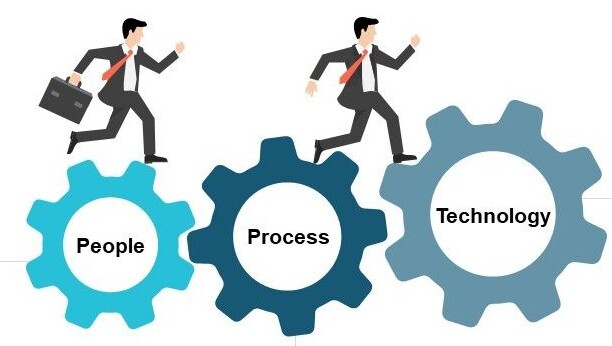
Back in my Industrial Engineering days, I learned a simple but powerful concept: People, Process, and Technology, are the key to any meaningful change. It makes intuitive sense. Progress used to come from individuals mastering their craft. As they improved their work, teaching others to do the same required describing the how into a Process – ways to achieve repeatable excellence. Tools and technology then came in to support and reinforce those processes, making success more effortless.
As industries become more advanced and complex, organizations develop physical and information systems to accelerate the growth. It is a journey of continuous improvement and optimization. The critical insight: It has to start with the right order—people first, then process, then technology. When these elements are aligned and congruent, the whole system works harmoniously.
Transformation projects tend to fail not because the technology’s capability, but insufficient upfront work of defining business requirements properly or missing people and process integration support through the change. As a result, we may live with large scale systems that are overly complex – we would only use a subset of their functionalities, while paying the complexity taxes in dollars and time. Or we have processes that are either unclear or too rigid for the environment we operate in – resulting in the need for workarounds.
People, Process and Technology are like gears of transformation. They need to operate in optimal speeds for the whole organization to run smoothly. Otherwise, grinding will occur, causing friction and wasted energy. The machine can continue to run, but at the risk of long-term damage or, worse, accidents. As seen in the 2023 FAA near-miss incidents: Air traffic systems (Tech) and protocols (Process) advanced, but chronic understaffing and burnout (People) created systemic risk.
The Current Reflection and Dilemma
Fast forward to now, Technology has advanced rapidly. AI can now build personalized software that can automate routine tasks. We can pull Process best practices from vast bodies of researches and playbooks (e.g. Total Quality Management, Lean, Six-sigma, Integrated Business Planning, etc.) and apply to core functions instantly, avoiding starting from scratch.
But here’s the challenge: despite these technological leaps, we have not invested at the same pace to reflect the delicate balance on our People. Our work norms and principles - how we learn, communicate, collaborate, have largely held similar patterns and evolved in reaction to shockwaves such as the establishments of global/diverse teams and remote/hybrid work.
Why? Because the accumulated investments in processes and systems over the years have been enormous. Since the commercialization of Generative AI, trillions have been or will be spent on data centers, research and development, and optimization. These investments are powerful, and the temptation is strong (because every company is doing it), but they only work when aligned with the people who use them, in support of the relevant processes.
Turning the Dials of Transformation
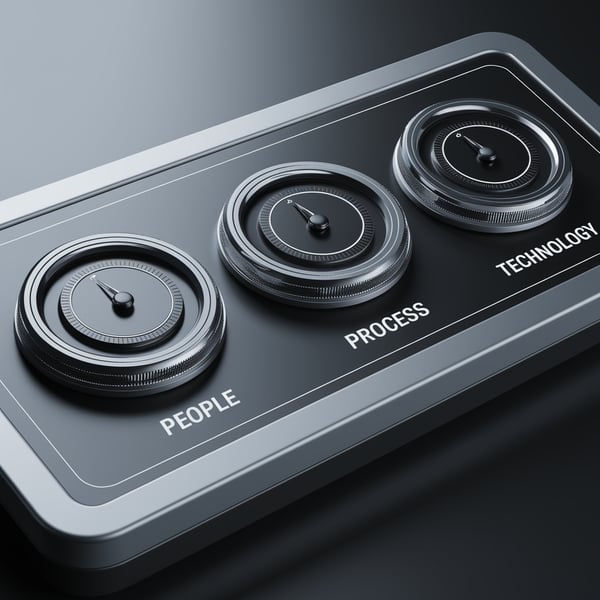
Picture the imaginary dials on People, Process and Technology. In pursuit of innovation and efficiency, organizations have been cranking up the Technology and Process dials. Budgets flowed into new platforms, automation, and AI. Processes were redesigned, streamlined, and optimized. Meanwhile, the People dial—investment in training, space for true team-building, and opportunities for meaningful collaboration—was too often dialed down. When the margin pressure was on, these were the first to go.
When organizations crank up the Technology and Process dials while dialing down the People dial, the gears of transformation begin to grind. We are now seeing the real-world effects of that imbalance. Even with cutting-edge tools and efficient processes, teams find themselves stuck in silos. Change initiatives stall, not because the systems are lacking, but because people aren’t fully engaged or connected. Employees report feeling more isolated, less in sync with each other, and further from the mission that is supposed to unite them.
How can we dial up our People?
To address the incongruence between people, process and technology, we can dial up our people by:
- Make Collaboration Non-Negotiable: Don’t just talk about teamwork—bake it into how work gets done. Shift from individual heroics to shared wins by setting goals that require input and cooperation across functions. (Example: In healthcare, Mayo Clinic's model is built on mandatory collaboration. Doctors are salaried and not paid per procedure, which removes the incentive for individual heroics and fosters a team-based approach to patient care, directly linking collaboration to better outcomes.)
- Align Communication with Action: Replace the biases to meetings and emails with clear, shared routines: written updates, transparent project boards, and regular (but concise) alignment check-ins. Make it easier for teams to know what is happening and where they fit, even as tech and process evolve. (Example: When Zoom implemented ‘Async Fridays’ (no meetings) and trained teams to use collaborative docs, productivity rose 20%.)
- Build Feedback into the Work, Not Around It: Waiting for annual reviews to surface issues is too slow. Use short, simple feedback loops - retrospectives, “start/stop/continue” check-ins, or even quick pulse surveys - to surface friction and fix it before it festers. (Example Adobe's "Check-in" system that replaced annual reviews with ongoing conversations improved retention by 30%.)
- Connect Training Directly to Team Needs: Forget generic workshops that cover “just in case” knowledge. Equip teams with training and resources that speak to actual, in-the-moment gaps: tools for better cross-functional communication, frameworks for shared problem-solving, playbooks for navigating new tech. (Example: AT&T's Future Ready initiative that reskilled 100,000+ employees with personalized learning paths based on evolving team requirements.)
- Recognize and Reward What You Want More Of: If you want real collaboration and collective progress, reward it. Celebrate teams who break silos, who document their learnings, who pull others into the win. Spotlight the behaviors that drive congruence, not just individual output. (Example: Google's 'Peer Bonus' system is a prime example. Any employee can nominate a colleague for a small cash bonus for having helped them out. This explicitly rewards the collaborative behaviors—helping, sharing knowledge, breaking silos—that drive congruence, not just the easily-measured individual output.)
- Use Simple, Shared Metrics: Measure what is changing, not just what is easy to count. Track and share concrete signals: reduced meeting load, fewer dropped balls, stronger cross-team project delivery, sustained engagement scores. (Example: HubSpot famously transitioned from tracking individual 'Marketing Qualified Leads' (MQLs) to a shared 'Customer Success' metric that both sales and marketing teams were responsible for. This forced collaboration and ensured marketing didn't just generate leads, but leads that sales could actually close and retain, reflecting the health of the entire system)
The good news? Turning up the People dial doesn’t mean you’re falling behind on the others. It means you’re finally getting the full benefit of everything you’ve already put in place. When teams are congruent - aligned in purpose, equipped to collaborate, and empowered to challenge and improve the system - technology and process improvements start delivering returns you can see and feel, not just measure. And the results will be a multiplier, ensuring all the gears of your organization turn smoothly and powerfully in unison.
0 Comments Click here to read/write comments
Let’s talk about something every CEO says: “People are our greatest asset.” We’ve all nodded along to the quote:
“If you leave us our money, our buildings, and our brands, but take away our people, the company will fail. But if you take away our money, our buildings, and our brands, but leave us all our people, we can rebuild the whole thing in a decade.” P&G’s former CEO Richard Deupree.
It’s powerful. It’s right. It’s also incongruent: “our greatest asset” is accounted for as… an “expense”. We capitalize factories. We depreciate equipment. We analyze return on capital. But trust? Culture? Leadership capacity? Those don’t live on our balance sheet. They live in the background, until they erode enough to surface as performance issues.
So, if people are truly the most valuable asset, where’s the investment strategy? Where’s the leadership allocation? Where’s the accountability for return on invested leadership?
Mind the Gap
This is the tension we see inside so many high-functioning leadership teams: The message is people-first. The mechanics don’t often match-up. We say people matter most. But when budgets get tight, what's the first line item on the chopping block?
- Leadership development becomes a “nice-to-have.”
- Culture work gets postponed.
- Reflective space disappears from calendars.
This is incongruence - the growing gap between what we say and what we build. And as we explore in “Mind Your How”, the how matters more than ever in moments of complexity. Because the how is what people feel. The how is what culture registers.
The Expectations Nobody Says Out Loud
There’s another, quieter form of incongruence at play in most organizations between what’s expected and what’s accepted. We expect our people to:
- Take initiative.
- Model accountability.
- Navigate ambiguity with resilience.
- Lead without burning out.
But what do we accept / tolerate in meetings, in calendars, in how leaders show up? What do we incentivise and reward?
Do we call out the gap between our cultural aspirations and our lived behaviors? Do we track the human equivalent of return on assets and hold ourselves to reconciling the difference? If the expected return on a factory dropped by 20%, we’d do variance analysis to death. We’d run scenarios. We’d adjust inputs. We’d double-click dashboards. But when people performance dips; when trust is low, clarity is frayed, or the energy in the room is off; how often do we unpack that delta with the same level of rigor?
This is precisely what we help teams do in Sharpening Team Practices—a session designed to turn well-meaning intentions into reliable, aligned behaviors. Because it’s not just what you say you value. It’s what you repeat, reinforce, and evolve.
As we explore in “Echoes in the Room”, the signals are there. But if we don’t have the space, the courage, or the method to name them, they compound. Quietly. Systemically. And that’s when culture starts to drift.
Where Leadership Lives or Unravels
Every leader wants to create a resilient organization. But resilience isn’t a metric. It’s a muscle. And like any muscle, it requires reps.
Yet here’s the quiet truth: most CEOs we meet have gone years without a space to strengthen that muscle. They’re surrounded by data and decisions—but not depth. Their calendars are full, but their clarity is frayed. They carry culture. They carry outcomes. But who helps them carry congruence?
This is why we built the Congruence Series: to help leaders stop treating alignment like a one-and-done event, and start seeing it as a dynamic capability.
We need the ability to dynamically align … together and in real-time
Rethinking ROI: Return on Intentionality
So, what if we redefined ROI? Not only as Return on Investment. But also, as Return on Intentionality. What if we treated our people strategy with the same rigor as our capital strategy? What if culture wasn’t just what we believe, but what we practice, measure, and protect? What if leadership development was a reward for performance, AND a prerequisite for congruence?
We’ve seen it time and again: when a team pauses to recalibrate, the ripple effects are real.
- Trust deepens.
- Communication sharpens.
- Energy returns.
- And leaders stop leading on fumes.
This isn’t theoretical. It’s lived. And the leaders who commit to it aren’t just better at business. they’re clearer, calmer, and more congruent.
Final Thought: It's Not a Poster | It's a Practice
“People are our greatest asset” should be more than a wall decal. It should be a design principle.
A capital strategy. A leadership imperative. So, here’s the reflection we leave you with:
Where in your business are you saying one thing… but building another? And what would it take to close that gap – not with platitudes, but with practice?
Because that gap? That’s where leadership either comes alive…or begins to quietly unravel.
Curious where your team stands on congruence? Explore the Team Congruence Assessment or connect with us to create a space where leadership isn’t performed – it’s practiced.
0 Comments Click here to read/write comments
What makes one team click while another clatters? Why do some teams produce exceptional results, while others - with the same resources - struggle to find momentum? And perhaps most curiously, why do some underperforming teams feel great to be a part of, while high-performing ones feel… exhausting?
Welcome to the subtle, often overlooked world of team dynamics - the space where performance meets alignment.
At Beyond Frontiers, we’ve spent years working with leaders and organizations to uncover the invisible levers of team effectiveness. One powerful lens we’ve developed is the Team Alignment & Performance Quadrant - a simple framework that reveals a great deal about what’s really happening inside a team.
Each quadrant doesn’t define a team’s identity - it describes a moment in time. A situation. A pattern that can shift. Every team will likely cycle through more than one of these states. The value of the framework is not in the label, but in the learning and the movement it enables.

🔵 Congruent: High Performance / High Alignment
This is the sweet spot. Teams here are in sync, results-driven, and emotionally connected. Communication is clear. Trust is high. Conflict (when it happens) is healthy, not toxic. Teams that find themselves in this situational construct prove to be both resilient and energized, able to weather setbacks and bounce back stronger.
Environment: High trust, clear purpose, and mutual accountability fuel not just results, but resonance.
- Identity/Belonging: Individuals feel seen for who they truly are, not just for their roles. They experience deep belonging rooted in shared values and respect for personal differences.
- Agency to Impact Change: Every voice feels consequential. People believe they can shape both the immediate work and the culture itself. Agency is lived, not promised.
What it feels like: Purposeful. Energizing. There’s clarity on where the team is headed, and trust in how everyone’s showing up.
| What one hears? | |
| Team Members Say | Leader Says |
| “We’re in sync.” | “This team owns the mission.” |
| “I know what’s expected of me.” | “I’m able to think strategically.” |
| “I feel like I’m making a difference.” | “They deliver without me needing to chase.” |
| “We trust each other.” | |
Risk: Complacency - thinking it’ll last forever without effort.
Most Effective Intervention: Stretch assignments, future-scenario planning, team storytelling to preserve cultural strengths.
Why it matters for HR: This is a model environment. Prioritizing these teams helps scale strong culture and develop future leaders.
"The echo here is coherence - the team’s spoken and unspoken messages align, strengthening both execution and identity."
🟡 Safe: Low Performance / High Alignment
Team members in this situational construct feel great - warm, safe, and close. But results lag. Accountability is fuzzy, and hard conversations are often avoided. Loyalty is high, but so is inertia. They need clarity, structure, and a collective push toward performance.
Environment: A warm, supportive culture exists, but urgency and execution falter. Harmony is prioritized over hard conversations or bold action.
- Identity/Belonging: Individuals feel emotionally safe and accepted. However, comfort can lead to complacency, dulling the edge of growth.
- Agency to Impact Change: People feel heard but not always called to act. Initiative exists but is inconsistently channeled toward meaningful change.
What it feels like: Warm, caring, and loyal - but missing drive. Decisions drag, accountability is soft, and goals feel secondary to harmony.
| What one hears? | |
| Team Members Say | Leader Says |
| “We’re like a family.” | “I don’t want to break what’s working, but we need to perform.” |
| “It’s a great place to work, but…” | |
| “We don’t move fast.” | “It’s hard to hold people accountable.” |
| “I wish we had clearer goals.” | “I’m walking on eggshells.” |
Risk: Burnout from over-caring and under-delivering.
Most Effective Intervention: Realignment workshops, coaching on performance expectations, peer accountability rituals.
Why it matters for HR: Cultural strength can obscure underperformance. With support, this situation has great potential. Left unaddressed, it risks complacency.
"The echo here is comfort - a collective affection that can unintentionally blunt ambition."
🔴 Fragile: High Performance / Low Alignment
From the outside, teams in this situational construct look like rockstars. But inside? It's tense. People are delivering, but relationships are frayed. Competition trumps collaboration. Trust is low. They are walking a tightrope - one misstep away from burnout or breakdown.
Environment: Results are delivered, but the effort feels brittle. Energy is spent managing tensions between visible success and hidden misalignment.
- Identity/Belonging: Individuals often feel valued for output over authenticity. Belonging is conditional - tied to performance, not personhood.
- Agency to Impact Change: Agency is limited and transactional. Speaking up feels risky, and most choose silent adaptation over open contribution.
What it feels like: Busy, productive - but strained. The team gets results, but beneath the surface is friction, fatigue, and fraying trust.
| What one hears? | |
| Team Members Say | Leader Says |
| “We hit targets, but at what cost?” | “They deliver, but it’s unsustainable.” |
| “I don’t feel like anyone cares.” | “I’m constantly putting out fires.” |
| “It’s every person for themselves.” | “I don’t know if they’re bought in.” |
| “There’s no feedback loop.” | |
Risk: Silent attrition and sudden collapse.
Most Effective Intervention: Trust-building offsites, leader vulnerability coaching, shared goal alignment.
Why it matters for HR: The risk of burnout and disengagement in this situation is high. Early support can prevent deeper morale and retention issues.
"The echo here is strain - beneath the achievements lies a quiet erosion of commitment and personal connection."
⚫ Dysfunctional: Low Performance / Low Alignment
Teams in this situational construct are in the danger zone. Disconnected, demotivated, and often checked out. Conversations are guarded. Goals are unclear. Morale is low. But even here, there's a path forward - if the team is served with courage to name what’s not working and get help.
Environment: Confusion, distrust, and reactive behaviors dominate. Priorities conflict and communication fractures, leaving teams spinning.
- Identity/Belonging: People feel isolated and self-protective. Identity fractures under the pressure to survive rather than thrive.
- Agency to Impact Change: Agency feels like a myth. Individuals either withdraw or act out in self-preserving ways, seeing little hope for real influence.
What it feels like: Draining. The team is stuck, suspicious, and disengaged. Meetings are avoidable, decisions unclear, and energy low.
| What one hears? | |
| Team Members Say | Leader Says |
| “No one knows what’s going on.” | “I feel like I’m yelling into the void.” |
| “I don’t feel heard.” | “Nothing sticks.” |
| “It’s chaotic.” | “I don’t know how to fix this.” |
| “What’s the point?” | |
Risk: Talent drain, stagnation, and reputational damage.
Most Effective Intervention: Third-party team diagnostics, conflict resolution, systemic reset of expectations and purpose.
Why it matters for HR: This is a red-alert zone. Avoiding the discomfort only delays deeper issues. Action here signals care, commitment, and responsibility.
"The echo here is dissonance - a cacophony of unmet needs and unseen possibilities."
Final Thought
When we listen carefully to the echoes in the room, we uncover more than just the visible performance or stated alignment of a team. We hear the deeper forces of individual identity, belonging, and agency at play. True congruence is delivering results while creating spaces where people feel seen for who they are and empowered to shape what comes next. Fragility, safety, and dysfunction each carry distinct signals of how belonging and agency are either nurtured or suppressed. The more we attune to these subtle dynamics, the more we can foster teams that move not just faster, but deeper - where leadership is not about control, but about creating the conditions where real transformation can emerge.
Every team moves through different states - none of them are fixed or fated. The quadrant isn’t about judgment. It’s about insight. The power of this model isn’t in labeling teams. It’s to spark reflection and unlock movement. Because once you know where you are, you can decide where you want to go and how to get there.
This is where the Team Congruence Assessment can be a meaningful action step.
Every leader wants results. But too often, we chase performance metrics without understanding the underlying team culture that drives (or drags) those results. In our years of practice, we have determined that the leaders’ role is to “Read the Climate. Create the Conditions. And recognize Contributions”.
If you’re a leader who’s ready to have the right conversations, or an HR partner looking for a shared language to support your teams, let’s talk. We’ll help you uncover your team’s current quadrant and chart a path toward sustainable performance and alignment.
Don’t guess. Diagnose.
Don’t settle. Shift.
📚 Relevant Reading List:
- The Five Dysfunctions of a Team - by Patrick Lencioni
- Team of Teams - by Gen. Stanley McChrystal
- No Rules Rules - by Reed Hastings & Erin Meyer
- An Everyone Culture - by Robert Kegan & Lisa Lahey
0 Comments Click here to read/write comments
The hallmark of strong and effective leadership is the quality of teams they assemble and nurture into achieving their individual and collective goals.
Some people like sports analogies, I prefer superheroes; Avengers, The Justice League, Fantastic Four or the X-Men, take your pick! Fictional as they may be, they speak to the aspiration and possibility every leader can appreciate. I venture that the code for building resilient teams that overcome the impossible is congruence! Congruence between work and the people doing the work unlocks the possibility for fulfillment, cohesion, and resilience that endures.
Yet, often in the dynamic world of work today, the foundational work necessary to create congruence is easily overlooked. Instead, we hope that our “wins” will create the virtuous cycle delivering congruence as a side-effect. Daniel Kahneman would call this an “outcome bias”. I call it throwing spaghetti on the wall and praying for it to stick! It is akin to hoping for the championship at the Superbowl before ever assembling a team that knows how to play together. (Yes, I gave in – sports analogies are great too!)
In the case of our super congruent superheroes, it is the meticulous organization, systems of accountability and support, development, resources and technology that enable them. While these markers of congruence are not always front and center, they are undeniably present.
Bottom line, preparation matters, as does the order of things. If you do it well enough, it may fade into the background, but its effects are a thing of beauty. It is the secret-sauce we all want the recipe to, for undeniable results we can count on, and a team that is capable and enabled to deliver.
The Congruence Code
Congruence is the harmonious alignment of purpose, roles, and relationships within a team. It ensures that the people, their work, and the environment in which they operate are in sync and continue to flow together. When this is achieved, teams can weather setbacks with minimal friction, adapt faster, and rebound stronger. Without congruence, minor challenges can lead to inertia, drain the team’s energy, causing miscommunication, burnout, and inefficiency.
The Real Work
The challenge lies in shifting focus from what feels good and easy to the intentional development of processes and relationships that produce desired results consistently over-time. This requires investing in clarity around purpose, roles, and processes—essentially creating an infrastructure for deliberate thinking and intentional decision-making. When people understand their "Why" (their purpose), and "Mind Their How" (the processes they’ll follow), they are less likely to become overwhelmed by ambiguity. Instead, they respond to uncertainty with creativity and resolve.
Snowball Effect of Congruence
Organizations that prioritize congruence unlock exponential potential. They don’t just survive crises—they become antifragile, using challenges as opportunities to grow stronger. Think Avengers in Endgame!
Congruence enables:
- Enhanced Resilience: Teams with high congruence recover from setbacks faster because they share a common language and purpose. They waste less time pointing fingers and more time problem-solving.
- Accelerated Learning: Congruence fosters trust, and trust creates a safe space for honest feedback. This accelerates learning loops, enabling teams to iterate and improve at a pace others can’t match.
- Sustainable Cohesion: Congruence builds a foundation of mutual understanding, reducing friction over time. Teams can focus their energy on innovation rather than navigating interpersonal conflicts.
Congruence isn’t just a strategy—it’s the architecture of sustainable excellence. By flipping the script and focusing on alignment before chasing outcomes, teams can create environments where fulfillment and cohesion thrive.
Let’s start with congruence.
0 Comments Click here to read/write comments
There is a connection between brand positioning and the internal culture of an organization. When these elements are in alignment, they create a positive effect. Throughout my professional journey working with major brands, I’ve observed consistent patterns that underscore why this alignment is crucial.
Here are a few thoughts on how to foster this positive connection.
1. Ownership and Pride
When a team understands how their work contributes to the brand’s promise, it ignites a sense of commitment and pride. Delivering an exceptional experience to customers becomes a collective goal. When leaders clearly communicate how everyone contributes to customer satisfaction through the brand, it energizes the team and gets everyone excited.
When each team member recognizes their impact on the consumer, a sense of ownership develops. Frontline staff know they are the face of the brand for consumers and that their actions directly influence customer satisfaction and loyalty.
2. Consistency Across Touchpoints
When the brand’s message aligns with the internal culture, it creates a seamless experience for customers. This is especially important in the details. Each interaction with the brand—whether marketing, sales, or post-sale support—should deliver the same promise, reinforcing its value in the consumer’s mind.
When everyone, regardless of their role, understands how vital their work is to delivering the brand’s promise, the consumer experience remains consistently positive. This consistency ensures that when customers engage with your brand, they receive an experience that reinforces your values and encourages continued preference for your brand.
3. Marketing Strategy as the Business Strategy
A well-crafted marketing strategy not only communicates who you are to the world but also rallies teams within your organization. Grounding internal communications in how the brand serves consumers helps everyone see how their efforts contribute to adding value. This makes work more meaningful and closely aligned with the outcomes that matter to consumers.
From my observations during major repositioning projects, when leaders emphasize why every person’s role matters to consumers, it fosters a culture where everyone feels connected and motivated to uphold the brand promise. This alignment between internal culture and external messaging cultivates a sense of ownership and pride in serving consumers, not just the company.
In conclusion, achieving congruence between your brand positioning and internal communications is essential for creating a motivated team and delivering business results. When everyone understands how their role impacts consumers, you build a company that not only satisfies its customers but also instills a sense of ownership and pride in employees, as each one plays a part in delivering value to consumers.
0 Comments Click here to read/write comments
The concept of Mind Your How emphasizes the importance of understanding the complex elements and connections that underpin our work. Team congruence is often linked to how well team members understand their roles and the collective practices that guide their interactions. When teams are congruent, there is a shared understanding of how decisions are made and how tasks are accomplished. This alignment is cultivated through intentional habits and practices. For example, a team that regularly reviews its decision-making processes can adapt and evolve these practices over time, ensuring they remain relevant within the organization’s cultural context.
Learn from Consumer Practices
In the product world, innovators study consumer practices to understand how they carry out tasks and why they do things the way they do. Consumers are smart and creative – if a product or solution does not exist (either through availability or affordability), they will come up with compensating behaviors to accomplish their goals. Once at an in-home visit, I observed a consumer manually stirring a load of laundry before starting the machine cycle. Why? Because she has been failed before by laundry powder that did not completely dissolve, requiring a rewash that would cause her money and time. The job of the brand would be to come up with an elegant or efficient solution to reduce or eliminate the need of those compensations.
One on One of Possibilities
One of most valuable practices for new hires to people managers to executives is one on one conversations. It can take place on a weekly, monthly or ad-hoc basis, you can cover topics from priorities for the week to long term career discussions. Depending on the nature of your role and relationship with the other person, they can take place in many forms.
- With your manager - weekly: share your priorities and show your work to get feedback
- With your peers in other departments - monthly: connect to check in on current initiatives and how you can support your respective teams
- With your mentor - quarterly: brainstorm opportunities to get experiences beyond your current role for your development
- With a new contact met at an event - one time: explore each others' paths and interest and the possibilities to help each other or work together
There is no one best way to do this, and you can mix and match to suit your goal. As you become more experienced, it will be second nature for you to apply a helpful practice for the occasion.
Team Decision Making
Teams form practices out of the reality and options they have. Take Decision Making as an example. Unless formally structured, each company / team has slight variations on how they make decisions. Who’s involved in the process? What inputs do they consider? How do they bring ideas to the table? Who gets the final say when there are differences in opinions? These are all elements of our team culture – while some practices are more helpful than others given the circumstances. Sometimes we hear stories about teams taking too long to make a decision, but that may turn out to be a wrong question. Why? Imagine two different scenarios:
- A strategic, billion-dollar decision involving multiple businesses and functions
- An operational issue where speed is of the essence and we already have the team closest to the matter at the table
Should we apply the same discipline and vigor to both situations? Our practices should reflect the goals and constraints at hand and be flexible.
Once we understand how our practices were established, we will make an important recognition that this is not a discussion about right or wrong. It is a journey on applying and adjusting more helpful ways to achieve our goals. Improving Team Congruence requires Commitment to the cause, Curiosity to level up our craft, and practices happen to be how they come to life. We can often improve performance by making our practices more relevant and effective.
What practices on your team do you find helpful that should be shared more broadly?
0 Comments Click here to read/write comments